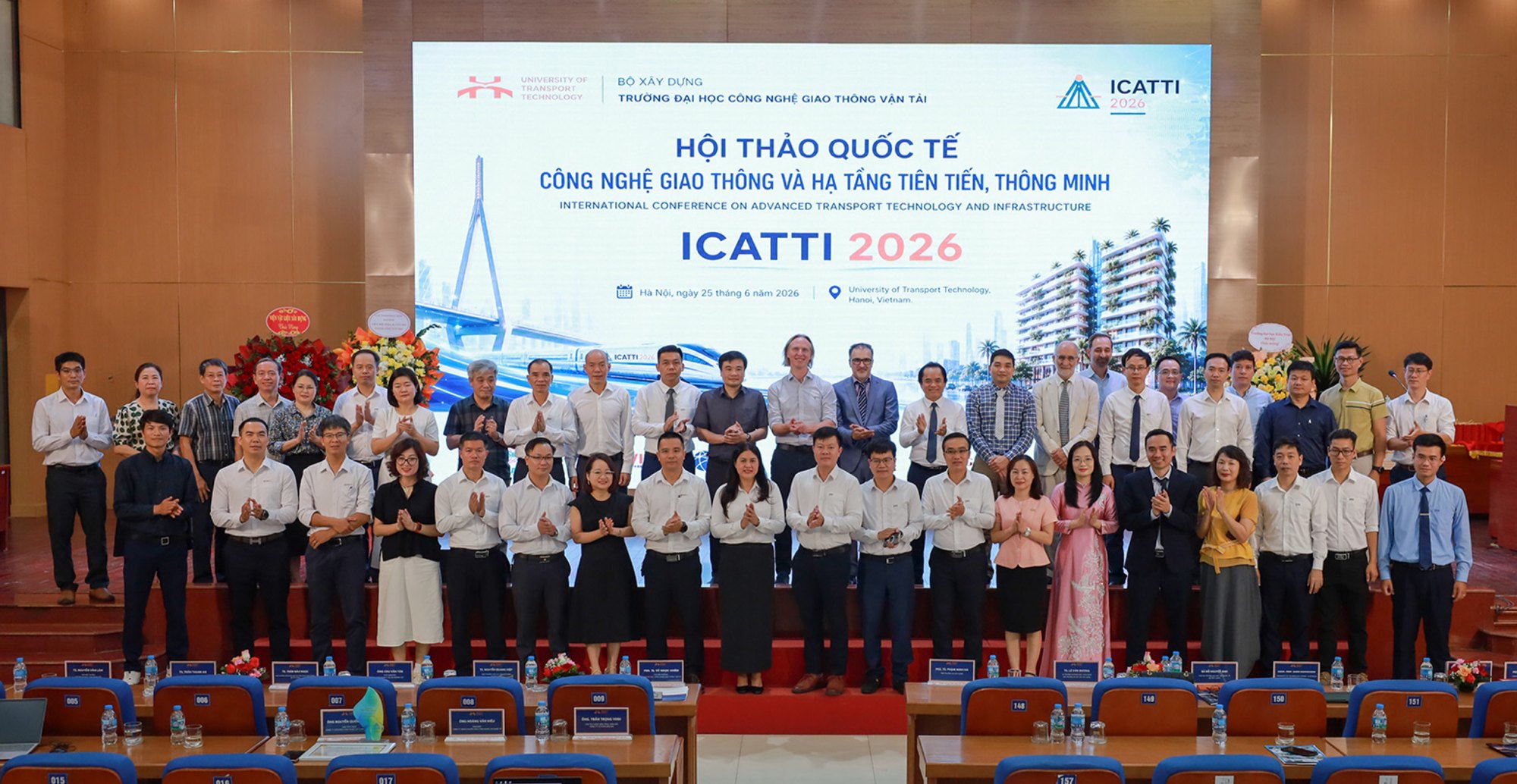
ICATTI focused on one central question: what scientific, technological, training and cooperation capabilities does Vietnam need to build in order to progressively master large-scale infrastructure projects in the future?
Section 1
A forum linking international knowledge with domestic infrastructure needs
Over two days, 25-26 June 2026, the University of Transport Technology organised ICATTI 2026, the International Conference on Advanced Transport Technology and Infrastructure. Across four working sessions, the conference brought together scientists, international experts, lecturers, researchers, enterprises and specialised units in transport, construction and modern infrastructure.
The content arc extended from high-speed railway and smart infrastructure, through sustainable materials, structures and technology transfer, to BIM, Digital Twin, AI and applied cooperation models. As a result, ICATTI 2026 did not stop at presenting research results. It became a space for dialogue between academic knowledge, enterprise needs and the infrastructure challenges Vietnam is facing in a new development stage.
Section 2
Opening session: academic foundations for high-speed railway and smart infrastructure
On the morning of 25 June, the opening session began with welcome remarks by Assoc. Prof. Dr. Vu Ngoc Khiem, Vice Rector of UTT. He introduced the conference theme, smart technologies for high-speed railway and transport infrastructure, and speakers from Australia, Spain, the United States and Vietnam. He also reviewed several recent achievements of the University: the Journal of Science and Transport Technology (JSTT) entered the Scopus database three years after its establishment and reached Q3 ranking the following year; UTT lecturers have participated in developing more than 100 technical standards for high-speed railway and electrified railway. He also mentioned two tasks assigned to the University: acting as the focal point for national railway workforce training under the assignment of the Ministry of Construction, and leading the network of excellent and talented training centres in advanced and intelligent transport technology and infrastructure under the assignment of the Ministry of Education and Training.
Policy direction from the Ministry of Construction
In his policy remarks at the opening session, Assoc. Prof. Dr. Pham Minh Ha, Deputy Minister of Construction, described ICATTI 2026 as a forum connecting academia with policy, technology, training and practical cooperation for major tasks of the sector. He placed the conference in the context of Vietnam entering a stage of implementing a series of high-speed railway, electrified national railway and urban railway projects, bringing new requirements in technology, standards, data, management models and human resources.
The Deputy Minister emphasised the need to progressively master technology, standards, data and people instead of only receiving them from outside, in the spirit of Resolution 57-NQ/TW on science, technology, innovation and digital transformation, Resolution 71-NQ/TW on education and training, and the Railway Human Resource Development Project under Decision 2230/QD-TTg. He raised a series of questions for the conference: which capabilities Vietnam should prioritise mastering first; how standards, regulations and data systems should be standardised; how BIM, Digital Twin and AI should be integrated into design, construction, management and operation; and which capability groups should guide workforce training.
For the University of Transport Technology, he proposed developing strong research groups, linking research with laboratories, real data and enterprise needs, while selecting several directions that can produce concrete, verifiable and transferable outputs, from calculation tools, simulation models and verification processes to data platforms and training programmes. He noted that only when the State, universities and enterprises coordinate closely, with each side clearly defining its contribution, can Vietnam form sustainable endogenous capability.
“Where there is a project, there must be people who master that project.”
Following the policy remarks, the academic part of the opening session began with the lead report by Dr. Khuong Le Nguyen, lecturer at the University of Transport Technology, and two international keynotes on high-speed railway and smart infrastructure. As Vietnam faces a series of large-scale infrastructure projects, especially high-speed railway, the presentations suggested a broader view: beyond building routes, stations or bridges, infrastructure development is also the task of building long-term capability in research, standards, simulation, verification and human-resource training.
With the topic “Research, Training and Numerical Simulation Orientations for the Development of High-Speed Railway in Vietnam”, Dr. Khuong Le Nguyen's lead report set the common frame for the whole conference: from the national challenge of high-speed railway to the need to build capability in numerical simulation, data, human-resource training and international cooperation. The report connected the University's strategic direction with the capacity of its research groups and the specialised content of later sessions.
On that foundation, Prof. José M. Goicolea focused on high-speed railway bridge dynamics, computational methods and design standards. These are critical issues. As operating speeds increase, the technical problem no longer stops at checking static load capacity: bridges, tracks, trains, substructures and operating conditions form a coupled dynamic system in which vibration, operational stability, ride comfort and running safety must be assessed together.
Next, Prof. Sybil Derrible's keynote expanded the discussion toward adaptability, resilience and intelligence in infrastructure systems. Modern transport infrastructure is part of urban, economic, social and environmental networks, and can hardly be treated as separate individual works. This systems approach clarified a requirement for future infrastructure: not only to operate efficiently under normal conditions, but also to stand firm against risks, disruptions and long-term change.
By combining the lead report with the two international keynotes, the opening session established three questions that later sessions needed to answer: how to calculate dynamics according to the right standards, how to make infrastructure systems resilient enough, and where domestic capability should be built from.
Section 3
25 June afternoon: materials, structures and technology transfer for sustainable infrastructure
On the afternoon of 25 June, the Faculty of Civil Engineering organised the thematic session on materials, structures and technology transfer for sustainable infrastructure, with participation from many scientists, experts and enterprises. If the morning laid strategic and international foundations, the afternoon brought the focus closer to implementation conditions in Vietnam: new materials, smart structures, foundations, sustainable infrastructure and pathways for bringing research results into practice.
The presentations showed that sustainable infrastructure cannot be separated from innovation in materials and structures. As requirements to reduce emissions, extend service life, optimise lifecycle cost and improve resilience become increasingly urgent, directions such as green materials, advanced structures, foundation solutions and construction technologies need to be connected directly with enterprises and real projects. Presentations by Assoc. Prof. Dr. Pham Minh Thong, Assoc. Prof. Dr. Ho Si Lanh and specialist groups clarified this approach.
A notable point of the afternoon was its spirit of linking research with application. Enterprises and specialist units did not attend only as guests; they brought concrete problems: which technologies are attracting attention, which difficulties are slowing transfer, what data and standards are still missing, and how the University can accompany training, testing, verification and solution development.
Section 4
26 June morning: BIM, Digital Twin and AI, from data governance to AI-integrated intelligent systems
On the morning of 26 June, the conference moved into the thematic session on BIM, Digital Twin and AI in transport infrastructure, attracting many enterprises, technology experts, lecturers, researchers and students. Opening the session, Dr. Tran Thanh An, Vice Rector of UTT, raised directly the gap between awareness and implementation: after many years of speaking about BIM, Digital Twin and AI, the real questions are whether the data is good enough, whether coordination processes are clear enough, whether people are ready, and whether these technologies have truly entered the daily work of authorities, consultants, contractors and universities.
The presentations in the session answered from several directions: the overall picture, project organisation, the data foundation, concrete AI applications and the reliability of results.
Opening the technical exchange, the keynote by Assoc. Prof. Saeed Banihashemi, Digital Transformation Research Group Leader at the University of Technology Sydney, outlined the larger picture: where digital technology can create value across the lifecycle of a work, from design and construction to operation and maintenance. He also stated a condition repeated throughout the session: these technologies only create value when accompanied by data governance, information standards and suitable verification mechanisms.
From his experience leading a VDC division at a major contractor in the United States, Hung Nguyen, lecturer at the University of California, Berkeley, offered a view many delegates agreed with: however good the technology is, it is difficult to create value if contracts, organisational structures and responsibility allocation remain unchanged. To change technology, it is often necessary to change the way projects are organised and operated.
Next, Pham Van Bach, Chief Executive Officer of Baezeni software company, presented how a common data environment (CDE) is implemented and operated on a real project in Vietnam. This is a critical link: when data remains scattered and each party keeps its own version, higher layers such as Digital Twin or AI struggle to stand on solid ground.
The presentation by Nguyen Quynh Lien, Chief Executive Officer of Harmony Advanced Technology, showed that AI is entering very concrete daily tasks for engineers: reading PDF drawings, supporting rebar arrangement for hundreds of bored piles in Revit, generating perspectives for quick review, retrieving model data, updating spreadsheets and drafting reports. These are all tasks that previously consumed many hours of manual engineering work.
The report by Dr. Khuong Le Nguyen, the session moderator, raised another question about reliability: when AI says “this model is missing 18 components”, is that number real or only a model's guess? The team introduced AGENTIC-IFC, an approach for AI agents to work with IFC models in a verifiable way: instead of only question-answering on a model, the system uses tools, MCP, skills and workflows to retrieve data, create issues with evidence, export coordination reports and lay the foundation for Digital Twins that can be traced backward later.
The session closed with a roundtable with guests from the management agency, technology enterprises and design consulting: Ta Ngoc Binh, Head of the Department for Investment Economics and Digital Construction Research at the Institute of Construction Economics, Ministry of Construction; Thang Anh Long, Chief Executive Officer of Structemp Digital and a BIM expert working in Europe; Nguyen Quynh Lien, Chief Executive Officer of Harmony Advanced Technology; Dinh Nho Cang, Head of TEDI's BIM and AI R&D group; together with speakers Hung Nguyen and Pham Van Bach. The exchange focused on a practical question: for BIM, Digital Twin and AI not to stop at slogans or demos, what does Vietnam need to prepare in people, data, processes and implementation mechanisms?
The bottlenecks were stated quite directly: the lack of unified data standards, the lack of real data to verify models, difficulty integrating digital workflows into projects, and a shortage of interdisciplinary talent. One direction mentioned was to select pilots that are small enough to start quickly but clear enough to evaluate within 6-12 months after the conference.
Section 5
26 June afternoon: extended academic exchange and specialised research directions
The afternoon of 26 June was fully scheduled with parallel sessions, opening more space for academic exchange and research connection. The technical presentation session gathered selected papers on advanced transport technology and infrastructure, ranging from digital information management, infrastructure monitoring, Digital Twin and transport systems to railway dynamics and structural safety. Notably, one online report addressed structural interaction under high-speed train derailment loading, a difficult safety problem that is rarely discussed.
In the same afternoon, the Faculty of Civil Engineering and the Railway Centre organised a specialist roundtable with Prof. José M. Goicolea and Assoc. Prof. Dr. Pham Minh Thong. Lecturers, researchers and students exchanged directly with experts on research directions for high-speed railway: bridge dynamics, numerical simulation, design standards, advanced structures and the development of research and training capacity within the University. The open atmosphere of this session showed that the conference achieved something more difficult than presentation itself: bringing international experience and domestic needs together for comparison and dialogue.
Section 6
From the conference to post-ICATTI cooperation
Looking back across the programme, ICATTI 2026 left three messages.
First, high-speed railway and modern infrastructure are above all a capability problem. The physical work is the visible part; behind it stands an entire system of design, verification, operation, data and people.
Second, directions in materials, structures, numerical simulation, BIM, Digital Twin and AI need to touch practical problems early. University research has stronger impact when placed alongside enterprise needs, project requirements, real data and clear evaluation criteria.
Third, post-conference cooperation needs to be made concrete through things that can be done. Six-to-twelve-month pilots, joint working groups, data sharing, short courses, model verification and technical guidance are practical steps for maintaining the momentum of cooperation.
ICATTI 2026 closed with many technical impressions and cooperation opportunities. The conference showed that the University of Transport Technology does not only train human resources for transport and construction, but also plays a connecting role in research, international cooperation, technology transfer and knowledge platforms for future infrastructure. This success provides a basis for the University to continue developing strong research groups, expanding partnerships at home and abroad, and contributing to the modernisation of Vietnam's transport infrastructure.